The African boubou is undoubtedly one of the continent’s most recognizable garments. Loose-fitting, flowing, and majestic, it embodies centuries of history, craftsmanship, and pride in one’s identity. Worn from Senegal to Nigeria, both at major ceremonies and in everyday life, this African garment transcends its mere function as clothing: it tells the story of a millennia-old African culture, shaped by trans-Saharan trade, the great empires of the Sahel, and the inexhaustible creativity of today’s artisans. This article invites you to discover the world of the boubou, from its distant origins to its establishment as a staple of African haute couture.
What is an African boubou?
Let’s start with the basics: what exactly is an African boubou? The term comes from the Wolof word “mbubb,” which originally referred to a long, flowing tunic. Today, it refers to a loose-fitting, voluminous garment, cut from several meters of fabric, that generally falls to the ankle. Its generous cut, far from constricting the body, instead offers complete freedom of movement and a natural elegance particularly well-suited toAfrica’s hot climates.
In its most refined form, the grand boubou is not worn on its own. The boubou traditionally consists of three pieces: a large outer tunic that is sleeveless or has wide openings, a long-sleeved shirt worn underneath, and matching pants tapered at the ankles. This three-piece ensemble gives the wearer an imposing and refined look. For women, the boubou can also take the form of a flowing African dress, worn with a loincloth tied around the waist or wrapped like a scarf.
The Origins of the Boubou: Ancient African Empires
To understand the boubou, we must trace its history back to the ancient Islamic empires of West Africa. The garment spread beginning in the 7th century, in the wake ofthe expansion of Islam and the intensification of trade across the Sahara. Berber merchants, who crossed the desert with their caravans, played a central role in this spread. Trans-Saharan trade carried not only gold, salt, and spices, but also fabrics, dyeing techniques, and influences from the Maghreb, the Arab world, and evenAsia.
The great West African empires —the Ghana Empire, the Mali Empire , and the Songhai Empire —gave rise to a refined elite for whom the boubou became a powerful symbol of social status. Wearing a high-quality, richly decorated boubou signaled wealth and power. This traditional African garment thus acquired a symbolic status in society very early on, initially reserved for dignitaries, Muslim scholars, and wealthy women. To learn more about this history, check out our feature onthe history of African fashion.
The Boubou Among the Peoples of West Africa

Helene Daba, co-founder of Sisters of Afrika
Although the boubou is a common garment, it goes by different names and takes on different forms depending on the culture inWest Africa. This diversity is what makes it so rich.
Among the Wolof people of Senegal, the mbubb remains a central piece of the wardrobe, particularly highlighted during religious and family celebrations. The Senegalese boubou, often made from rich bazin fabric, is the very embodiment of elegance. Among the Yoruba people of Nigeria, the equivalent of the grand boubou is calledthe agbada: this flowing, embroidered tunic, worn over a shirt and pants, is the quintessential ceremonial garment for special occasions. The Hausa people, found in Nigeria and Niger, also have their own version of this ceremonial garment, often adorned with striking geometric embroidery.
Further north, among the Tuaregs of the Sahara, the spirit of the boubou can be seen in their loose-fitting indigo robes. The traditional Tuareg garment, sometimes referred to as a k’sa, protects the wearer from the sun and wind while affirming their identity. This connection serves as a reminder that the boubou is not an isolated invention, but rather the result of ongoing exchanges between the peoples of the desert and those of the Sahel.
Fabrics and patterns, from bazin to wax
A boubou is defined as much by its cut as by its fabric. The choice of fabric determines its prestige, its intended use, and the season for which it is worn.
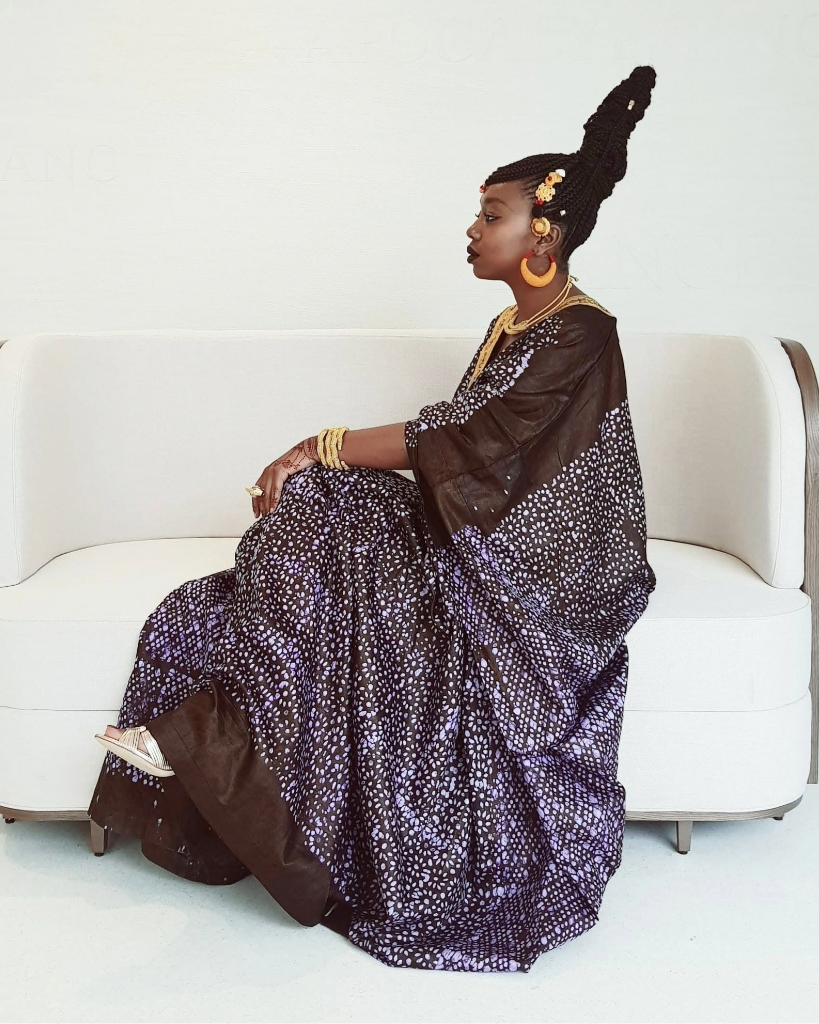
Bazin is undoubtedly the premier fabric for ceremonial boubous. This damask cotton, dyed and then beaten until it achieves a brilliant sheen, is the top choice for weddings and celebrations. Wax fabric, with its brightly colored prints, is used for more casual and creative outfits; its shimmering patterns and symbolic prints make it a language all its own. There are also batik boubous, made using a wax-resist dyeing technique that produces a variety of unique patterns.
Fabrics also vary depending on budget and intended use: in addition to high-quality natural fibers, many boubous are now made from synthetic materials, such as polyester, which are more affordable and easy to care for. The artisan’s craftsmanship remains central: hand-embroidering a boubou—on the neckline and front panel—can take days of work and transforms a simple tunic into an exceptional piece. To learn all about fabrics, check out our guide to materials used in African fashion.
Boubou for men, boubou for women
The boubou comes in elegant styles tailored to each gender, while retaining its characteristic loose-fitting silhouette.
The African men’s boubou has established itself as the quintessential formal attire for men. The long boubou, with its wide, flowing sleeves and impeccable drape, is often complemented by a matching headpiece, such as the chéchia, which completes the outfit with distinction. Some men prefer lighter, short-sleeved versions, while others opt for the majesty of the sleeveless style worn over a long-sleeved shirt. Find more inspiration in our African men’s fashion section.
For women, the boubou mirrors the flowing silhouette of the African dress. Women love to wear it in a long, flowing style, adorned with delicate embroidery or crafted from luxurious bazin fabric. It pairs naturally with other iconic pieces from the African and Mediterranean wardrobes, such as the caftan or the qamis, with which it shares a loose fit and a spiritual dimension. Our African women’s fashion section is full of ideas for putting together a memorable outfit, and our article on African dresses perfectly complements this overview.
A garment steeped in meaning

Mory Sako is wearing a boubou from the Abengta brand
Beyond its aesthetic appeal, the boubou holds deep cultural significance. In many societies, it marks life’s most important moments: baptisms, weddings, religious holidays, or family gatherings. Wearing a boubou means honoring a tradition, affirming one’s belonging to a community, and expressing respect for the occasion.
Colors and patterns are never chosen at random. Every shade and every embroidered symbol can refer to a social status, a region of origin, or a message. This coded dimension makes the boubou much more than just a garment: it is a true vehicle for collective memory. To learn more about this visual language, our article on the symbolic colors of African clothing offers fascinating insights.
We must also view the boubou as part of the broader family of traditional clothing across the continent. While it reigns supreme in West Africa, other garments tell parallel stories elsewhere, such as the kanga in East Africa. This diversity demonstrates just how rich and varied Africa’s sartorial heritage is.
The Boubou and Haute Couture: From Tradition to Afro Elegance
Far from being stuck in the past, the boubou is currently enjoying a spectacular renaissance. Many contemporary designers are embracing this iconic garment to reinvent it, modernize it, and propel it onto international runways. Nigerian designer Alphadi, nicknamed “the magician of the desert,” was one of the first to bring the boubou into the world of haute couture, proving that this ancestral garment could rival the world’s greatest fashion houses.
This renaissance has a name:Afro elegance. With reimagined cuts, blends of fine fabrics and synthetics,and bold prints… the boubou has become a canvas for a new generation of designers, inspired by a proud and vibrant African culture. It has now captured the imagination far beyond the continent, embraced by the diaspora and fashion enthusiasts worldwide. Discover the talents driving this excitement in our section dedicated to African fashion designers.
The boubou, a timeless symbol of African elegance
From the Sahara Desert to the Parisian runways, the African boubou has spanned the centuries without ever losing any of its splendor. A garment of great empires, a legacy of trans-Saharan trade, and a highly symbolic marker of social status, it remains today a powerful symbol of identity and refinement. Whether crafted from the finest bazin or a vibrant wax print, worn by a man in a full-length boubou or by a woman in a flowing African dress, it continues to embody the creative spirit ofAfrica.
Want to explore the fascinating world of African art further? Browse all our news in the Fashion section of Africa Fashion Tour, your go-to source for African fashion.
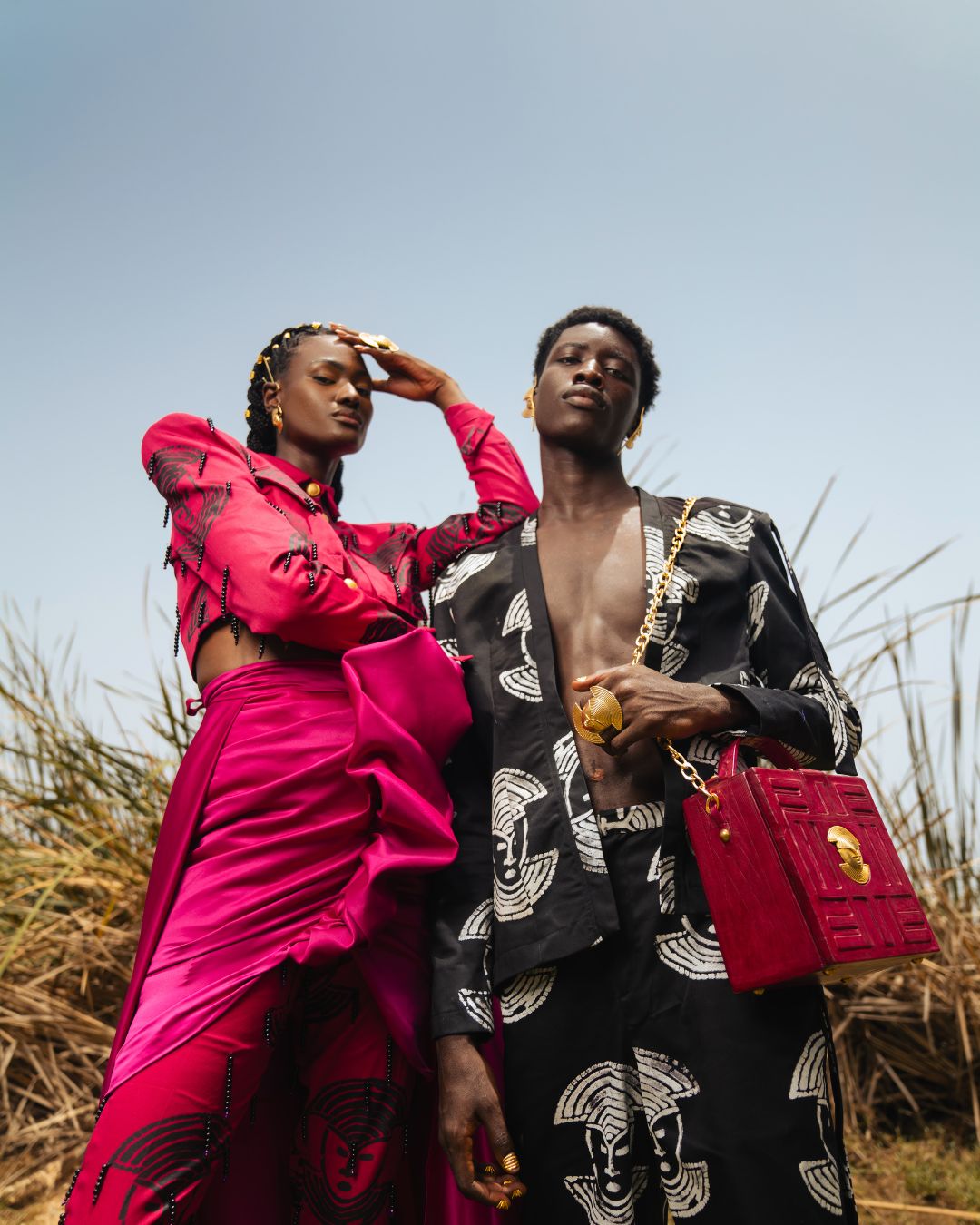
Photo 1: Fatou Ndiaye, Black Beauty Bag