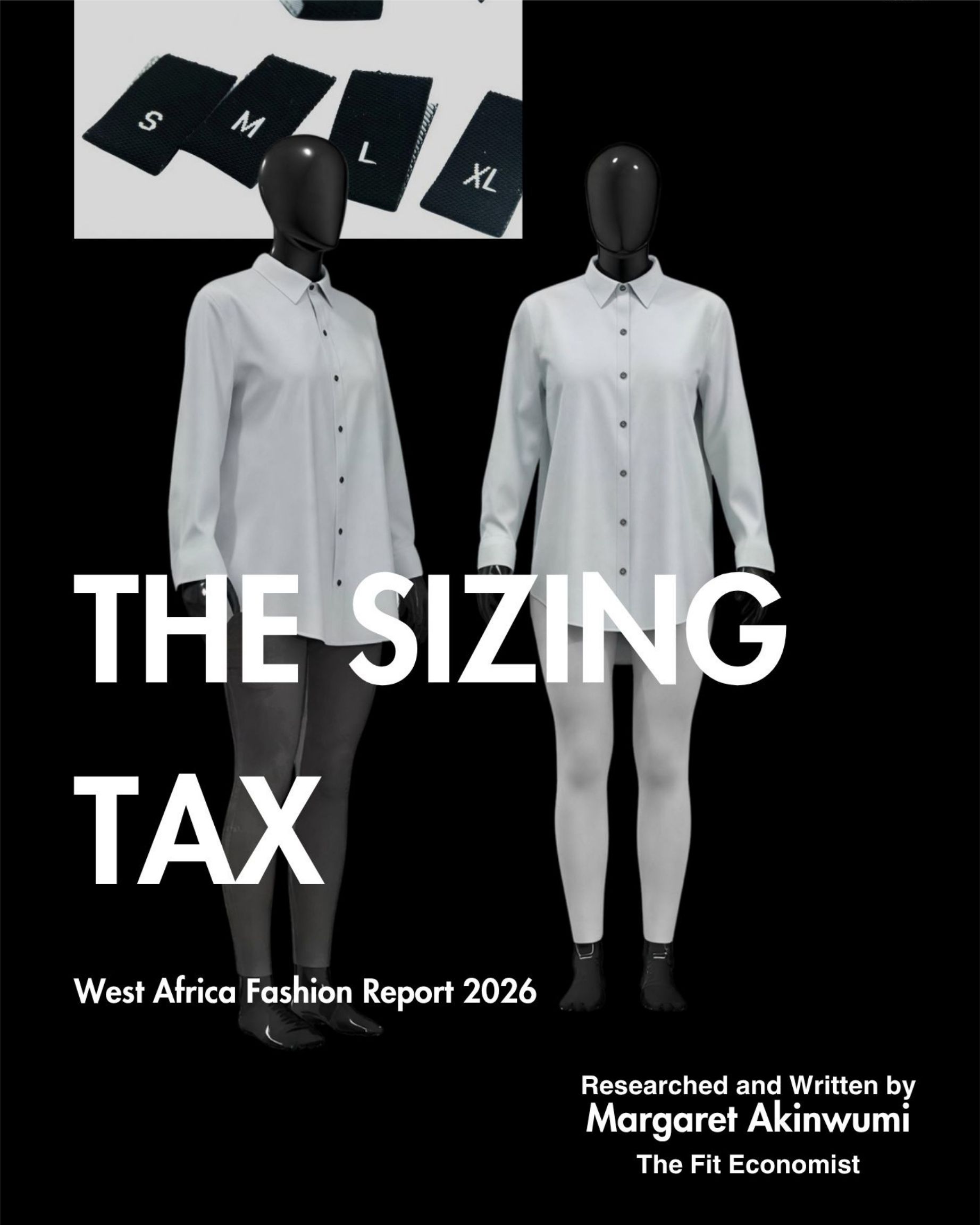
Through a rigorous audit of eleven iconic West African brands, this study demonstrates that size clarity is not just a technical design detail, but a major business driver directly linked to revenue.
Who is Margaret Akinwumi, “The Fit Economist”?
A specialist in sizing strategy and reducing return rates, Margaret Akinwumi has built her expertise in the field. Driven by a passion for precision in measurements after witnessing how cutting errors and unexpected returns were undermining the profitability of emerging African brands, she now studies the impact of sizing infrastructure on fashion e-commerce.
Through her firm, she advises brands and investors by applying a quantitative and strategic approach to fit and sizing issues. The publication of the report “The Sizing Tax 2026” marks the first independent study of its kind in West Africa.
What is the “Sizing Tax”?
The ” Sizing Tax” refers to the revenue a brand consistently loses because its customers are unable to determine with confidence whether a garment will fit them before clicking “buy.”
Margaret Akinwumi demonstrates that this invisible but very real tax revolves around three key components of financial loss:
- Abandoned shopping carts: Estimated at 12% of gross sales. Customers like the product but decide not to buy it because of uncertainty regarding the size chart (for example, measurements listed only in inches when the buyer measures in centimeters, or a lack of details about the model’s size).
- Size-related returns: These are customers who take the risk of making a purchase but receive the wrong size and return the product. The average return rate in Africa is estimated at 6% (artificially low due to high shipping costs and restrictive brand policies), 40% of which are directly attributable to sizing issues.
- Permanently Lost Customers: Estimated at 25% of customers who experienced a sizing issue. Disappointed by a poor experience, they stop ordering from the brand permanently without necessarily expressing their dissatisfaction.
In a moderate-risk scenario, the cumulative annual loss for the eleven audited brands amounts to $295,000.
Audit Methodology
The study was conducted over a six-week period between April and May 2026. Eleven brands of Nigerian and Ghanaian origin that sell directly to consumers (DTC) through their own websites at premium or luxury price points were evaluated.
Each brand was evaluated across five key dimensions of size intelligence (scored out of 20 points each, for a total score out of 100):
- Quality of the size guide: Measurements provided in both inches and centimeters; a clear distinction between body measurements and finished garment measurements; and an illustrated measurement guide.
- Fit Information: Always include the mannequin’s size and height, a description of the fit (fitted, oversized, etc.), and whether the fabric is stretchy or not.
- Pre-purchase customer support: Direct and practical channels for asking important questions before making a purchase (such as a dedicated WhatsApp button).
- Confidence in the Return Policy: Clarity and accessibility of the return policy, and the reasonableness of the timeframes for an international buyer or one based in Africa.
- Clarity of the product page: Overall usability and access to key information without having to leave the current product page.
Audit Results
The overall average score for the eleven West African brands is only 41 out of 100 (Grade D).
No brand received an A grade, which shows that sizing infrastructure remains the weak link in African fashion e-commerce, despite massive investments in brand identity and photography.
2026 Audit Ratings:
- [70–100] Grade A: No actors
- [60–69] Grade B: Andrea Iyamah (68/100)
- [50–59] Grade C: Christie Brown
- (53/100) [40–49] Grade D: Onalaja (47), Lisa Folawiyo (46), Nkwo (45), Fruché (45), Emmy Kasbit (50) [00–39] Grade F: Grey Velvet (36), Orange Culture (30), Style Temple (20), IAMISIGO (13)
Key Findings of the Audit
- Andrea Iyamah (68/100 – Grade B): This brand is the top performer in the audit. It has invested in communicating fit information (advice on sizes between standard sizes, measurements in centimeters and inches). However, the lack of model heights and a strict return policy for swimwear (no cash refunds, only store credit) prevent it from achieving a Grade A.
- Onalaja (47/100 – Grade D): Although positioned in the high-end price range, the brand has the highest Sizing Tax cost in the study. This is due to a very high average order value combined with an extremely strict return policy: “No returns. No exchanges. All sales are final, ” which discourages hesitant buyers.
- IAMISIGO (13/100 – Grade F): The brand does not have its own functional e-commerce site. The entire shopping experience and size guides are handled by third-party retailers, which deprives the brand of control over its customer experience.
International Comparison
To measure the gap compared to international best practices, the study evaluated the e-commerce giant ASOS (which actively ships to West Africa) using the same assessment criteria. ASOS scored 93 out of 100 thanks to size guides by product category, customer reviews indicating whether an item runs large or small, an AI-powered recommendation tool, and a flexible 28-day return policy.
5 Cost-Free Solutions to Eliminate the “Sizing Tax”
According to Margaret Akinwumi, solving this problem does not require investing in complex artificial intelligence technologies, but rather implementing five simple and immediate solutions:
- Always include centimeters in size charts: Nearly all of the brands audited list sizes only in inches. French-speaking Africa and a large portion of the West African customer base measure in centimeters. Offering both units eliminates a major barrier to purchase.
- Specify the model’s height and size on each product page: Letting a customer who is 1.60 m tall know where a dress photographed on a 1.80 m tall model will fall helps prevent disappointment and abandoned carts.
- Add a “What if it doesn’t fit?” section to the product page: Clearly summarize and reassure the customer about the return policy (timeframes, exchanges, or refunds) right next to the “Add to Cart” button.
- Add a dedicated WhatsApp support button for sizing: African customers prefer instant messaging. Providing a quick response to questions about sizing helps instantly convert undecided customers.
- Extend the international return period to 21 days: A standard return period of 7 to 10 days is untenable for a customer who has to deal with cross-border delivery times and reship a product at their own expense.
By applying the issue of the size of the design studio to the finance committee, Margaret Akinwumi’s report demonstrates that the sovereignty of African fashion also depends on control over its distribution channels and respect for the body types of its customers.
Read also