Long forced to align with the schedules of Western capitals or limited to isolated seasonal events, Africa’s fashion weeks are demonstrating an unprecedented level of institutional maturity. The start of the 2026 season features an exceptional concentration of business events, major fashion shows, and commemorative celebrations.
The fashion ecosystem no longer seeks external validation: it is building its own distribution channels, attracting international buyers to the heart of its major cities, and consolidating events, some of which have been running continuously for more than two decades. This buzz demonstrates that African Fashion Weeks are now establishing themselves as indispensable B2B hubs and living laboratories for sustainable fashion.
Bamako Fashion Week and the Promotion of the Sahel’s Textile Heritage

Led by designer Mariah Bocoum and the Alliance of Fashion Designers and Creators of Mali (ACCM), the Malian capital came alive to the rhythm of the third edition of Bamako Fashion Week at the Modibo Keïta Memorial. As the direct successor to the Chris Seydou Fashion Week —launched in 2011 to pay tribute to the founding father of contemporary Malian textiles—the event has nearly fifteen years of history and has operated under its current name for over a decade.
The event in Bamako stood out for its program, which was firmly rooted in the region’s local resources:
- A celebration of the Sahel’s exceptional materials, from locally produced hand-spun cotton fabrics to bogolan textiles dyed using centuries-old techniques.
- The organization of professional masterclasses focused on branding, intellectual property protection for designs, and business management for young Malian fashion houses.
- Group fashion shows bringing together local designers with guest designers from across the West African subregion.
This initiative reaffirms Mali’s central role in the history of designer fashion and demonstrates that Sahelian arts and crafts constitute a modern and sustainable economic asset.
Lagos Fashion Week and the Celebration of Fifteen Years of Circular Innovation

A flagship event in English-speaking Africa, founded in 2011 by Omoyemi Akerele through her agency Style House Files, Lagos Fashion Week is celebrating 15 years of uninterrupted operation at the Federal Palace Hotel on Victoria Island. Recently honored with the prestigious international Earthshot Prize for its pioneering work toward a zero-waste world, the Nigerian platform is approaching this edition under the strategic theme “CRAFTED: Heritage. Innovation. Circular Futures.”
The program unfolds as a methodical journey combining high finance, runway shows, and private experiences:
- Opening business sessions and strategic panels held in partnership with the Africa Finance Corporation, accompanied by exclusive off-site presentations by Sisiano, Orange Culture, and the Alara x Emmy Kasbit alliance.
- Three days of intensive runway shows featuring more than fifty leading fashion houses, including Maliko, Oshobor, Christie Brown, Fruché, Ugo Monye, Éki Kéré, Bloke, and Studio Imo.
- A nomadic closing day throughout the lagoon metropolis, dedicated to studio runway shows and conceptual presentations by iconic labels such as Lisa Folawiyo, Andrea Iyamah, IAMISIGO, and Orire.
By combining regenerative textile engineering with the discipline of wholesale distribution, Lagos is establishing itself as the nerve center of the fashion industry in sub-Saharan Africa.
GTCO Fashion Weekend and Commercial Democratization in Support of Small and Medium-Sized Enterprises

Another highlight of the Lagos scene, the GTCO Fashion Weekend is celebrating its tenth anniversary at the Oniru site on Victoria Island. Conceived and fully funded since 2016 by the Guaranty Trust Holding Company banking group, this completely free festival brings together tens of thousands of visitors each year with a clear goal: to stimulate the growth of small and medium-sized creative businesses.
The format stands out for its powerful synergy between spectacular entertainment and immediate profitability:
- Ready-to-wear and haute couture fashion shows featuring major names such as Cameroonian fashion designer Imane Ayissi, the Senegalese brand Tongoro Studio by Diarrabousso, the Ivorian label Ibrahim Fernandez, as well as international guests like Fia Factory and Kim Shui.
- Free masterclasses led by world-renowned experts in makeup, art direction, and fashion design.
- A vast marketplace hosting hundreds of artisans, accessory designers, and cosmetics creators, offering these small and medium-sized businesses direct sales revenue without exhibition fees.
This initiative demonstrates that the partnership between the banking sector and the creative industries serves as a tangible catalyst for local consumption.
Isabelle Anoh’s Afrik Fashion Week and Twenty Years of Leadership in Abidjan
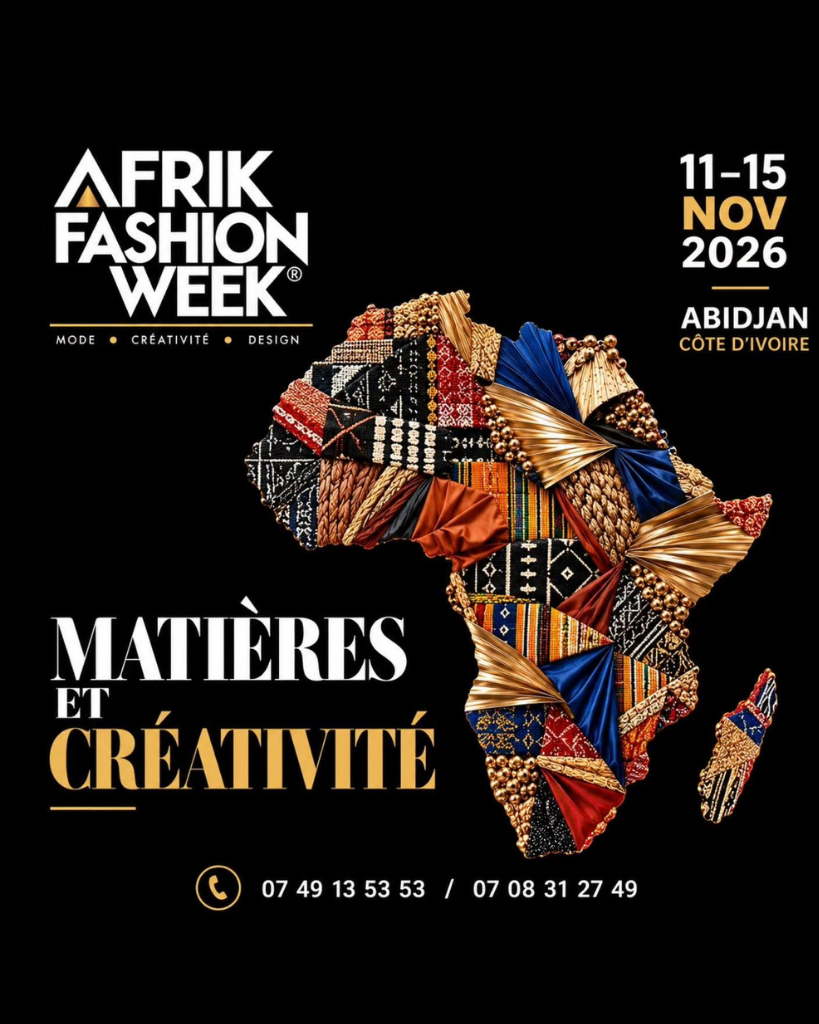
In Abidjan, the longest-running event in Ivorian fashion reaffirms its prominence at the Sofitel Abidjan Hôtel Ivoire and the Palais des Congrès. Founded in 2005 by journalist and communications specialist Isabelle Anoh, currently Director General of Leisure at the Ministry of Tourism and Leisure, the event—which began as the “Tendance Party” before becomingthe “Afrik Fashion Show” and then“Afrik Fashion Week”—has been running for over twenty years andhas held seventeen editions to date.
The program combines a community festival, high-quality performances, and intergenerational learning:
- Prestigious fashion shows featuring some 30 master tailors and leading contemporary designers, including Alphadi, Ciss St Moïse, Gilles Touré, Pathé’O, and Collé Sow Ardo.
- Strategic roundtables focused on the digitization of the textile distribution sector, the fight against industrial counterfeiting, and financing mechanisms for the West African apparel industry.
- Talent competitions for young patternmakers and honorary awards recognizing regional artisanal excellence.
By bringing together the industry’s veterans and the next generation, Abidjan is solidifying its position as an essential hub for Francophone elegance.
Dakar Fashion Week and Adama Paris’s 25th Anniversary

The event, founded in 2001 by designer and businesswoman Adama Amanda Ndiaye (Adama Paris), is marking a major milestone by celebrating its twenty-five years of continuous operation overlooking the Atlantic Ocean.
The program showcases the Dakar way of life through several iconic initiatives:
- A major retrospective tracing a quarter-century of stylistic boldness led by Adama Paris and the leading designers who have shaped the platform’s reputation.
- Monumental open-air fashion shows celebrating Téranga, West African hand-woven fabrics, traditional rabal, and sleek linen.
- Designer salons, exhibition sessions dedicated to emerging talent, and fruitful collaborations with Dakar’s contemporary art scene.
Dakar demonstrates that institutional longevity is the key to establishing a solid and exportable cultural diplomacy.
Fashion Week by Elie Kuame and the New Wave in Ivorian Haute Couture

Launched in 2024 by the Ivorian-Lebanese fashion designer Elie Kuame alongside his business partner Georgette Griffiths, La Fashion Week by Elie Kuame has established itself in Abidjan as a prestigious platform dedicated to the arts and crafts and haute couture.
Held at the Ivorian-Korean Sports, Cultural, and ICT Center (CSCTICAO) in Adjamé and the Donwahi Foundation, the event takes an approach focused on excellence:
- Competitions offering scholarships and international immersion internships, including the Marie-Thérèse Houphouët-Boigny Honorary Award and the Dominique Ouattara Award of Excellence.
- Heritage retrospectives celebrating the masters of Pan-African fashion, such as Pathé’O, Alphadi, and Chris Seydou.
- Group presentations featuring fashion houses from Côte d’Ivoire, Senegal, Mali, Ghana, Benin, and Nigeria, such as Simone & Elise and Metakay.
This new format is injecting fresh energy into the Ivorian fashion ecosystem by emphasizing technical rigor and elite training for the next generation of designers.
Libreville Fashion Week and the Cultural Revival of Central Africa

Launched in 2012 in the wake of the Africa Cup of Nations, Libreville Fashion Week is once again showcasing its vitality on the Esplanade de la Baie des Rois. With a 14-year history marked by several phases of transformation, the Gabonese platform is at the forefront of eco-design in Central Africa.
This dynamic revolves around strong identity-based themes:
- Synergy with public policies promoting cultural appreciation, supporting local commissions and the promotion of traditional attire in the workplace.
- The exclusive use of indigenous plant materials, ranging from raffia fabrics from equatorial forests to fibers from beaten bark and treated foliage.
- Large-scale regional casting calls and technical workshops designed to professionalize models and artisans from the Congo Basin.
This revival illustrates the determination of Central African capitals to develop their own leading fashion scenes and enrich the global textile discourse through their natural resources.
How African Capitals Are Setting New Industrial Standards
A look at these fashion weeks reveals a profound transformation: Africa is no longer content merely to put on a show—it is building markets. From the banking dynamism of Lagos to the cultural sovereignty of Bamako and Dakar, each metropolis is asserting its role in the global value chain.
By combining the celebration of historic anniversaries with the emergence of technically demanding platforms, the continent no longer seeks a place on the international calendar: it now sets its own pace, upholds its own ethics, and displays its own unique creativity.