Rethinking Logistics
Since its founding in 2015, PANAFRICA has distinguished itself through an ethical yet geographically dispersed sourcing model. Raw materials crossed several West African borders:
- Authentic wax print fabric was printed in Côte d’Ivoire by UNIWAX,
- The handwoven cotton came from the Mariette Women’s Cooperative in Burkina Faso
- The batik fabrics were hand-dyed by Esther in Ghana.
Final assembly, meanwhile, was carried out at Hicham’s workshop in Casablanca, Morocco. Although this approach had its merits, the geographic dispersion posed major logistical and customs challenges. Transporting semi-finished products within Africa often proved to be more costly and complex than importing finished products from Asia.
The opening of the “Panafrica Shoes Côte d’Ivoire” factory in Abidjan resolves these bottlenecks by centralizing final assembly right in the heart of its textile production zone. This relocation drastically reduces the brand’s carbon footprint while effectively capturing the African market, which already accounts for 25% of the company’s global revenue.
Training and Reintegration Through International Cooperation
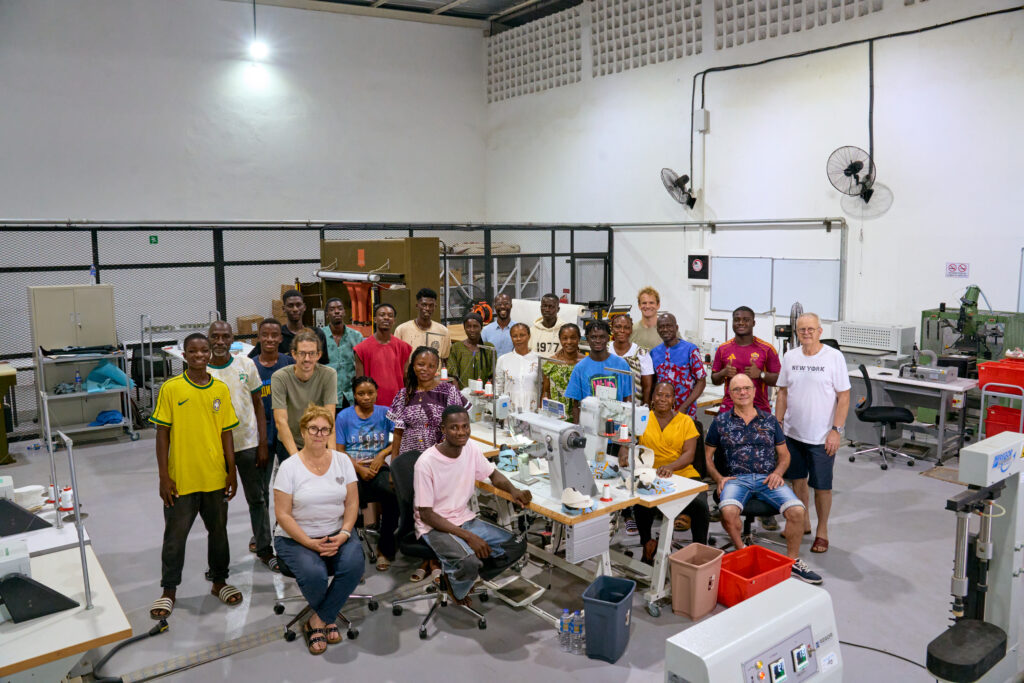
The new facility in Abidjan goes beyond mere manufacturing by incorporating a center for continuing vocational training. This dual-track model aims to establish a local technical footwear sector—a long-standing industry that has suffered from a lack of vocational training programs in the subregion.
To implement this social component, PANAFRICA has partnered with German development cooperation through the “Invest for Jobs” initiative, led by GIZ on behalf of the German Federal Ministry for Economic Cooperation and Development (BMZ).
Thanks to this partnership, 17 people who were far from the job market received intensive training lasting more than a month before securing a permanent position when the factory opened. The training program, which aims to fill 50 skilled positions within two years, covers both technical skills—such as stitching and sole assembly—and soft skills modules (workplace safety, waste management, and anti-harassment).
This commitment to excellence draws inspiration from high-impact models implemented across the continent, such as the one developed in Rwanda with the company Pink Mango Asantii, or the literacy programs established by PANAFRICA’s partner cooperative in Burkina Faso.
Synergies and the circular economy at the heart of the Ivorian hub
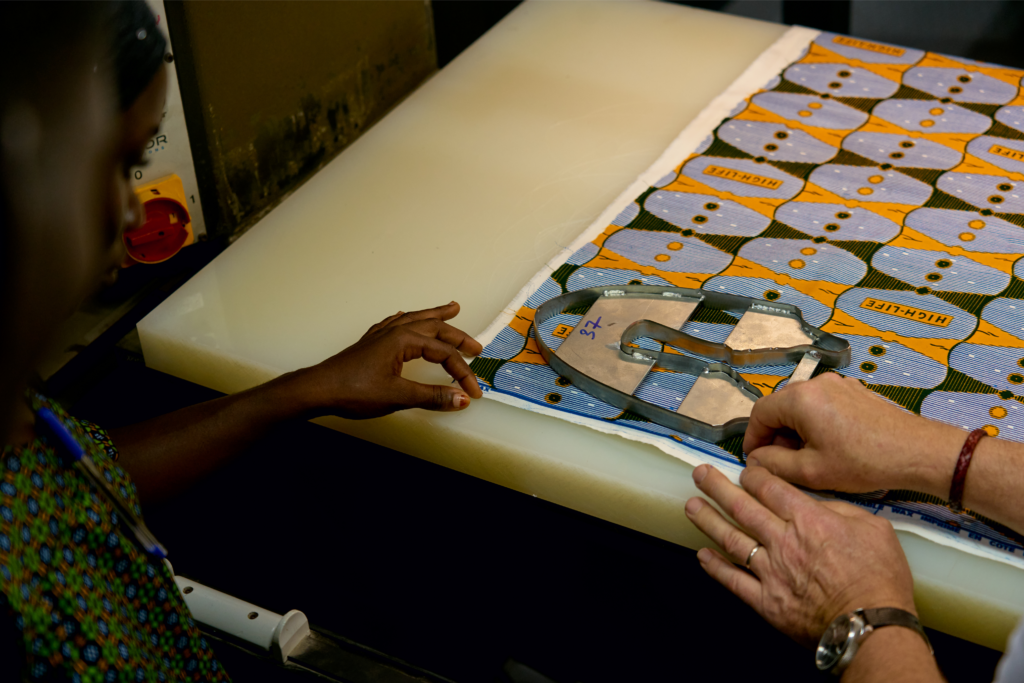
The decision to choose Côte d’Ivoire is also based on the strength of its long-standing industrial players. As a long-standing partner for wax printing, UNIWAX (based in Abidjan since 1968) ensures the brand a secure supply of high-quality wax, protected from low-cost counterfeits from Asia.
This vertical integration paves the way for advanced sustainability practices. As a pioneer with its “Arusha” deposit-return model—where consumers receive a €10 refund by returning their worn-out shoes for recycling— PANAFRICA plans to bring these waste recovery processes directly to Côte d’Ivoire. This represents a major step forward for the technological and environmental sovereignty of the African textile industry.
The Historic Shift Toward Economic Sovereignty
PANAFRICA’s industrial initiative is deeply aligned with the findings of the sector report “Africa Creator Economy Report 2.0 2026.” This document highlights that Africa’s creative industries are undergoing a decisive shift toward sovereign entrepreneurship. Global and local demand for African fashion, driven by digital soft power, requires large-scale operational structures.
This need to transition from artisanal production to industrial manufacturing is a long-standing struggle, often highlighted by legendary figures such as the Senegalese designer Collé Sow Ardo. For the “Queen of Woven Pagne,” the major challenge facing African design is no longer simply to showcase collections in Paris or New York, but to have autonomous, high-performance production facilities on African soil capable of fulfilling orders for thousands of pieces.
By opening its factory in Abidjan, PANAFRICA is proving that an eco-friendly model can be scaled up for industrial production without losing its soul. This rigorous production process and robust social traceability are the keys that will enable African brands to establish a lasting presence within major global distribution networks, as demonstrated by the recent successes of the pop-up stores at Galeries Lafayette and the Style Lounge Wearhouse in Paris.
The inauguration on July 1, 2026, is not only a success for PANAFRICA; it also heralds a new industrial era in which added value and technical expertise remain rooted on the continent.
Read also