
Deciphering a 565 million euro ambition
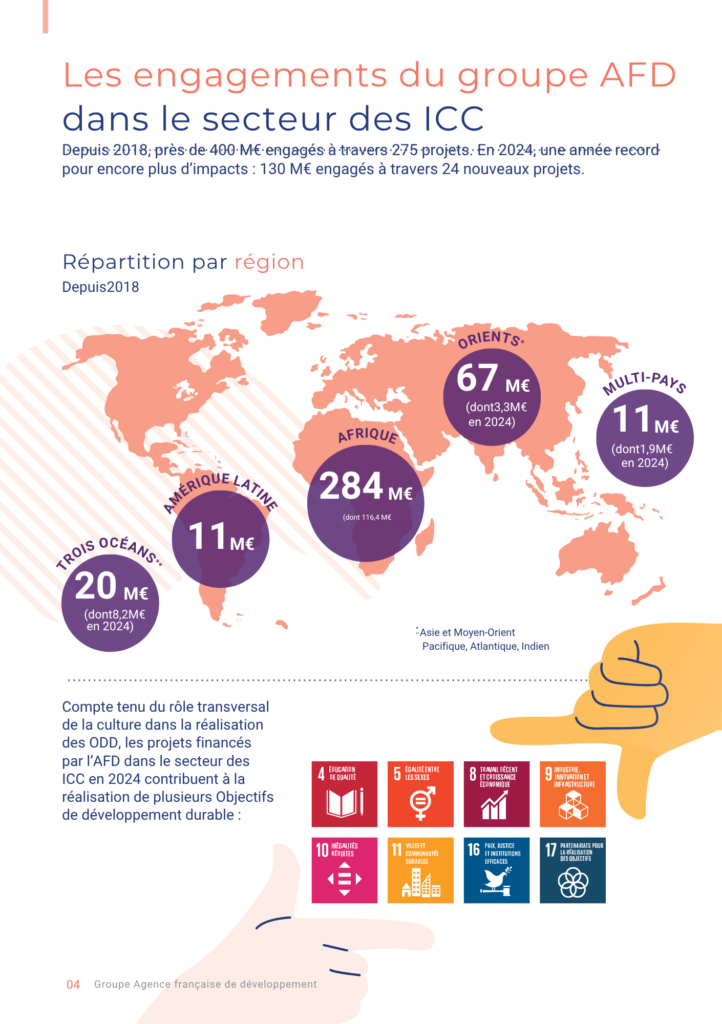
The year 2024 marked a historic turning point for Agence Française de Développement (AFD). This year alone saw the commitment of 130 million euros through 24 new projects, confirming that the Cultural and Creative Industries (CCI) are no longer a niche but a priority for sustainable development and a real Soft Power.
This acceleration is a strong signal that Africa, which accounts for 30% of AFD’s total commitments in this sector (i.e. some 284 million euros), is asserting its cultural sovereignty. Nearly 7.5 million people now have better access to the cultural sector thanks to these operations.
The four pillars of creative sovereignty
AFD’s approach is not limited to philanthropy. It aims to structure the entire value chain through four rigorous areas of intervention.
1. Governance and public policy
Talent is not enough without a protective legal framework. AFD engages in direct dialogue with governments to secure copyright and the status of the artist.
- The Benin model: With funding of 60 million euros (including 55 million in loans), Benin has become the laboratory for this ambition. This budgetary support accompanies a far-reaching reform designed to increase the contribution of culture to national GDP, while ensuring a fair redistribution of income.
- Expansion in Ghana: AFD is also supporting the Ghanaian Creative Arts Agency to structure music publishing and performance infrastructures, mobilizing the French expertise of SACEM and the Centre National de la Musique.
2. The new temples of modernity
Quality venues are essential if local people are to reclaim their own stories.
- Guinea (Sandervalia Museum): A 16 million euro loan is financing the rehabilitation and bioclimatic extension of the national museum in Conakry, with the aim of attracting young Guineans to its heritage.
- Benin (MACC): The construction of the Cotonou Museum of Contemporary Art (30 million euros) positions the country as a major regional hub for contemporary art.
- Zimbabwe: Additional funding to complete the interpretation center at the UNESCO-listed Great Zimbabwe site, to stimulate sustainable cultural tourism.
3. Excellence as standard
To export African fashion or cinema, technical skills are essential. AFD is banking on long-term training courses leading to a diploma.
- Senegal: The “FIT ICC” project (2.8 million euros) provides high-quality training in the audiovisual and performing arts sectors, promoting the direct integration of young people.
- Campus AFD: Through programs such as KreAfrica (in partnership with Trace Media) and the Djowamon platform dedicated to museum professionals, the Group uses digital technology to democratize technical knowledge.
4. Breaking the financial glass ceiling
Access to capital remains the major challenge. The Group deploys innovative financial tools to support the transition to scale.
- Afrique Créative: This emblematic incubation program has already supported 170 microprojects in 35 countries. Winners receive technical and financial support (up to €90,000) to structure their business model.
- CREAFUND: Implemented by Proparco with the European Union, this 6.5 million euro guarantee mechanism encourages banks and private equity funds to lend to cultural enterprises by covering part of their risk.
The strength of French expertise and research
AFD doesn’t work alone. It’s mobilizingTeam France: the Musée du Quai Branly, the Gobelins and Rubika schools, and even the INA are being called upon to transfer cutting-edge skills.
At the same time, scientific research is being carried out to change people’s perception of risk. The 2024 study on “Imagined Communities” shows how CCIs, through the prism of digital technology, are helping to build nations and social cohesion. The concept ofEdutainment (education through entertainment) is also being examined as a powerful lever for raising awareness of climate issues and gender equality.
“Cultural industries are not just a vector of emotion, they are an infrastructure of the mind necessary for any sustainable development.”
Towards Nairobi 2026
The Africa Forward 2026 summit in Nairobi will be the high point of this decade of investment. By making culture a pillar of bilateral cooperation, AFD is proving that Africa is no longer a passive land of influence, but the center of gravity of a new global creative economy.
This assessment is proof. The sector is ripe, the funding is there, and the infrastructure of the African imagination is finally under construction.
Sources :
- ICC 2024 Activity Report – AFD Group
- Culture and Heritage” strategy brochure – May 2026 edition
- Imagined communities and digital transformations” report (2024)
Read also