Deconstructing stereotypes and celebrating the diversity of Afro-culture
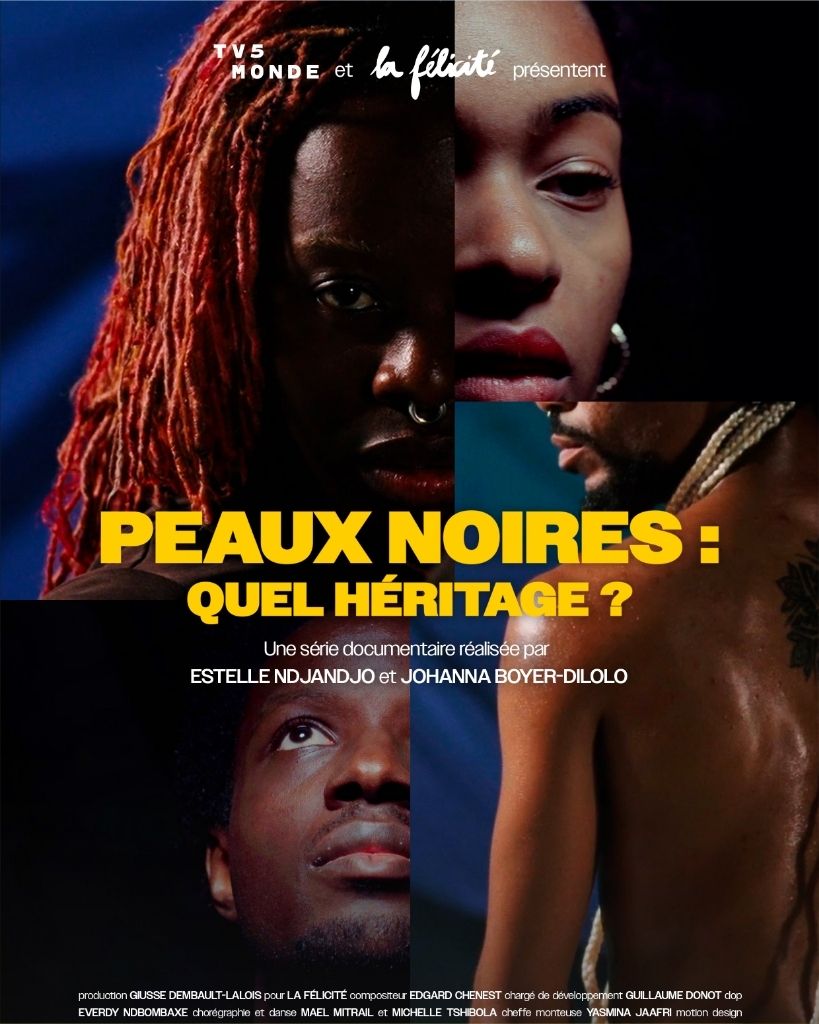
There are works that act as mirrors and amplifiers. This is precisely the case with “Peaux Noires, ” a five-episode, 15-minute documentary series written and directed by journalist and author Estelle Ndjandjo and lighting director and filmmaker Johanna Boyer-Dilolo. Produced by Guisse Lalois and broadcast on TV5Monde, this choreographic, poetic, and scientific work explores the intimate, historical, and political relationship with Black skin.
An Interview with Estelle Ndjandjo, a strong and passionate voice who rejects pre-packaged narratives.
Occupation: Journalist
For Estelle Ndjandjo, the path to documentary filmmaking was shaped by a crucial journey—both geographical and personal. In 2019, she left the newsrooms of Paris to settle in Dakar. Working first for Reuters and then for RFI, she discovered a Senegalese society characterized by immense modesty and politeness, whose social codes she came to understand. It was, in fact, this reserve in front of the camera that led this journalist of Cameroonian origin to turn to audio production and radio.
“In Senegal, the radio is everywhere: in taxis, maquis, and newsstands. Sound allows for an intimate form of communication—almost less vulgar than images.”
In 2020, as the world came to a standstill under the impact of the pandemic and erupted in protest following the murder of George Floyd, Estelle was living in Dakar, surrounded by a Black community where she felt, for the first time in her life, that she was “the norm.” This moment of collective pause allowed her to discover masterpieces of independent Black cinema (such as Julie Dash’s *Daughters of the Dust* or Jean-Pierre Bekolo’s *Quartier Mozart* ). Something clicked. She wanted to direct her own films to document stories that had been rendered invisible.
A sensory documentary blending dance, science, and animation
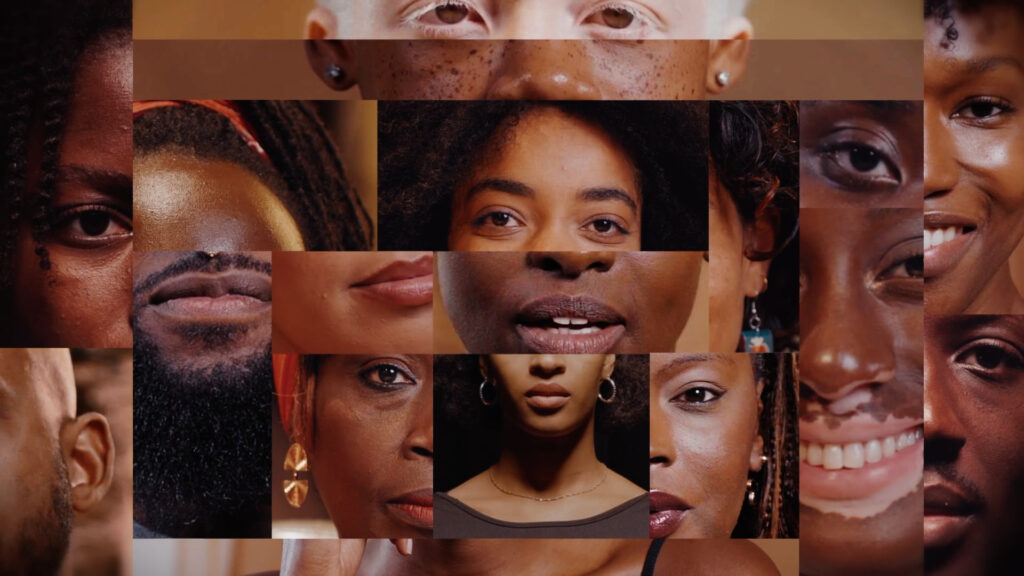
To tackle a subject as broad and sensitive as Black skin, Estelle Ndjandjo and Johanna Boyer-Dilolo rejected traditional investigative formats. Working closely with Yasmina Jaafri on the editing, they created a visual work that is both educational and artistic, with a distinctly modern feel.
The Art of Filming and Lighting Skin
Drawing inspiration from the color grading of the film *Moonlight* and building on the essay by Diarra Sourang, author of the book *How to Film Dark Skin*, Johanna Boyer-Dilolo brings her expertise as a director of photography. The goal is to create visual poetry for dark skin, to capture its deep reflections, and to reverse the historical Western paradigm that systematically associates darkness with impurity.
Dance as a Political Outlet
Suffering, fetishization, and the joy of being in one’s own skin are brought to life on screen through the moving bodies of dancers Michelle Tshibola, founder of the Afro-queer cabaret Vénus Noire, and Mael Mitrail. Their contemporary choreography and voguing-inspired movements lend a sensual and liberating dimension to the testimonies.
Fairy Tales and Geopolitical Developments
In collaboration with artistic director and motion designer Rokneddine Diaby, each episode unveils an illustrated world inspired by the aesthetics of fairy tales and hieroglyphs (Azur and Asmar, The Prince of Egypt). These sequences subtly demystify complex “founding myths,” such as the historical origins of colorism in slave-holding societies or the ancestral connection to shea butter and scarification.
Rigorous and inspiring experts
To convey scientific perspectives, Estelle has chosen to surround herself with leading figures of the new academic generation, such as sociologist Solène Brun, author of the book *Derrière le mythe métis*, and historian Nail Ver-Ndoye, author of the book *Noir entre peinture et histoire*. Ver-Ndoye focuses in particular on highlighting the presence of prestigious Black figures—ambassadors and knights—in Venetian and medieval art, far removed from the stereotype of mere servitude.
Emancipation in the Face of the American Model
One of Estelle Ndjandjo’s most interesting insights lies in her critical perspective on African American culture. While she deeply respects the icons of jazz and cinema who have inspired previous generations, she calls for a break from the influence of the United States.
“We need to stop looking solely to the United States. We’ve been making this mistake for too long. The American capitalist system—which has been particularly highlighted during the Trump era—does not consistently work in the interests of Black diaspora communities. ”
For the filmmaker, the future lies in the assertion of a sovereign Afro-culture. This culture no longer seeks permission or validation from traditional, predominantly white institutions. It asserts itself through its creative power and economic viability.
The most striking example of this cultural hegemony is undoubtedly Aya Nakamura, who was able to fill three consecutive Stade de France shows and invite a multitude of Black female artists on stage. Similarly, the creation of the Flammes ceremony—conceived as a necessary alternative to the Victoires de la Musique—proves that creators from the diaspora are no longer waiting to be invited to the table; they are setting up their own.
The Challenge of Tomorrow
For Estelle Ndjandjo, the struggle ahead is not limited to visibility—since Afro-French culture is already ubiquitous and dominant—but lies in diversifying narratives. It’s about refusing to confine Black people to stereotypes or preconceived notions of suburban life.
“Every Black person is multifaceted. The challenge is to gain acceptance for an alternative Black culture: goth, alt-rock, geek, or medieval history buff.”
Estelle applies this multifaceted nature to herself. A pop culture journalist for the Madame Figaro podcast *Scandales*, she is also writing a book exploring the revival of social Catholicism in France, the central role played by the Black diaspora in this movement, and the racial contradictions it faces.
With *Peaux Noires*, Estelle Ndjandjo and Johanna Boyer-Dilolo have created a work of public service, intended for screening in schools and political institutions alike. With grace and conviction, they remind us that Black history does not begin with chains, but with a rich civilization ready to express itself in all its complexity.
Read also