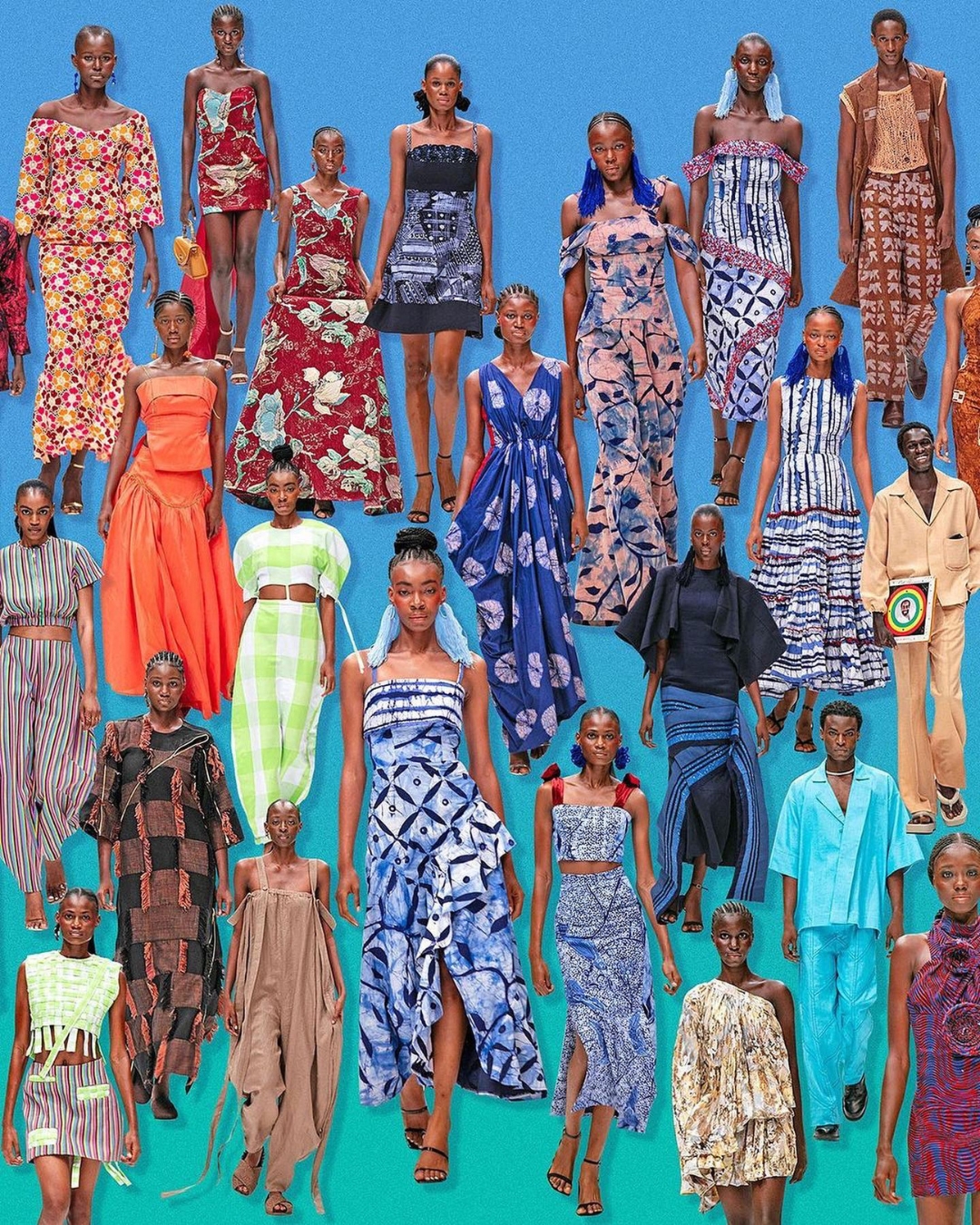
A legacy woven from childhood onward
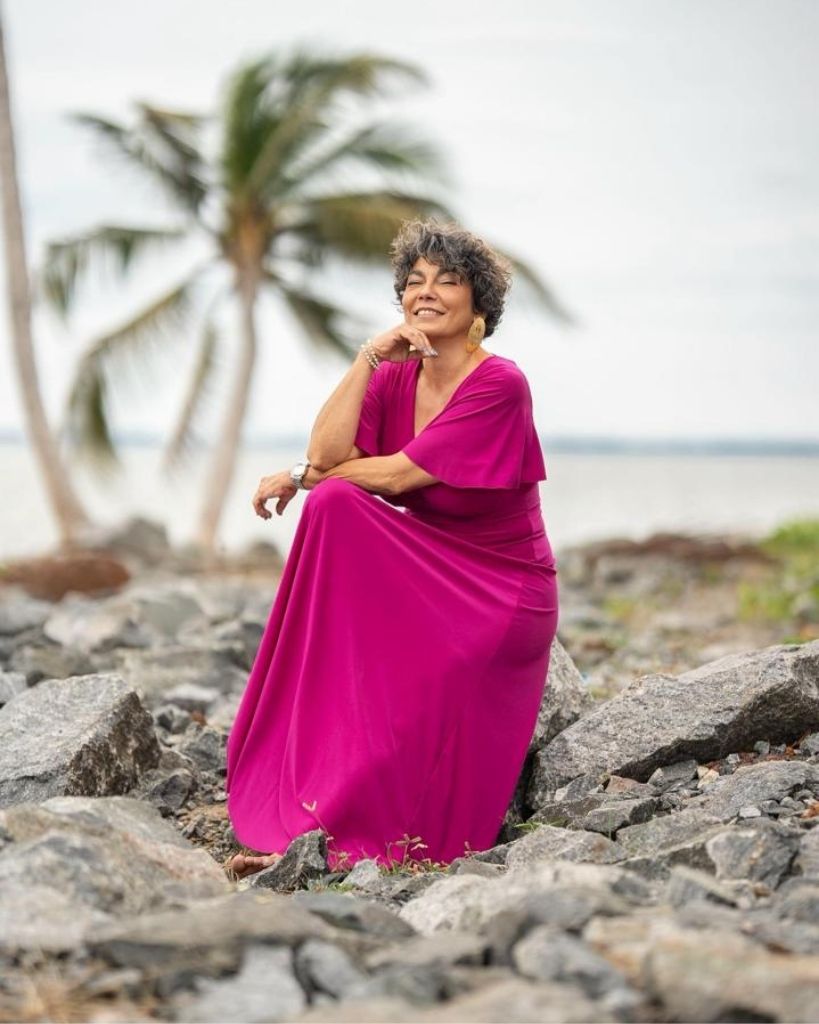
For Linda Alves Nunes, sewing isn’t a late-in-life career change, but a return to her roots—a family legacy that was evident from the very beginning. Born in Libreville, in the iconic Carrefour Léomba neighborhood, Linda grew up in a world filled with fabrics, patterns, and sewing machines. Her mother, Ángela—an elegant woman with deep Spanish roots—made local history by opening Libreville’s very first haberdashery in 1965.
“Ever since I was born, I’ve been surrounded by everything related to fabric and sewing. When I was 5, my mom gave me a little sewing machine for kids. Since I didn’t have any fabric scraps, I cut up the living room curtains to make a dress for my Barbie doll. That earned me a good scolding, but I was hooked. ”
Before devoting herself fully to the creative industry in 2021, Linda lived several lives in one. She worked successively in the airline industry, insurance, the commercial sector, and then in interior design. A person of mixed heritage with diverse roots, she defines herself as an “octavone,” possessing 1/8 Gabonese ancestry mixed with a strong Andalusian heritage on her mother’s side and Portuguese heritage on her father’s side; she spent several years in Málaga, Spain. It is this cultural blend—spanning the West, the Mediterranean, and Central Africa—that today shapes the artistic direction of Atelier Issé by Lita.
The Philosophy of Atelier Issé by Lita
The brand name is a heartfelt tribute to its origins and to a certain vision of femininity:
- “Issé” is a word from the Gabonese Nzebi dialect that means elegance, beauty, and harmony. It’s also a subtle nod to the Japanese master of draping, Issey Miyake.
- “Lita” is a reference to Ángelita, the affectionate Hispanic nickname for her mother, Ángela.
Through her collections, Linda Alves Nunes aims to redefine women’s presence and visual impact in public spaces. In a market saturated with demands where the body is often overexposed and bared, the designer advocates for an elegant, sensual, and modest alternative, bordering on “modest fashion.”
“Our body is a temple, something sacred. Exposing it without any filter makes no sense. You can be deeply sensual and sexy while wearing more modest clothing, enhanced by precise cuts, subtle slits, or well-thought-out draping that adds a sense of poise.”
Eco-friendly fashion focused on fibers from Central Africa
Linda Alves Nunes is one of those activist designers who refuse to take the easy route of adopting a uniform narrative on African textile identity. When asked about the systematic use of wax—that industrially printed fabric—her verdict is final:
“These days, there’s too much talk about the pagne. I’m outraged by this because the pagne isn’t African at all—I want to emphasize that. We’ve adopted it and integrated it into our culture, but it doesn’t come from Africa. ”
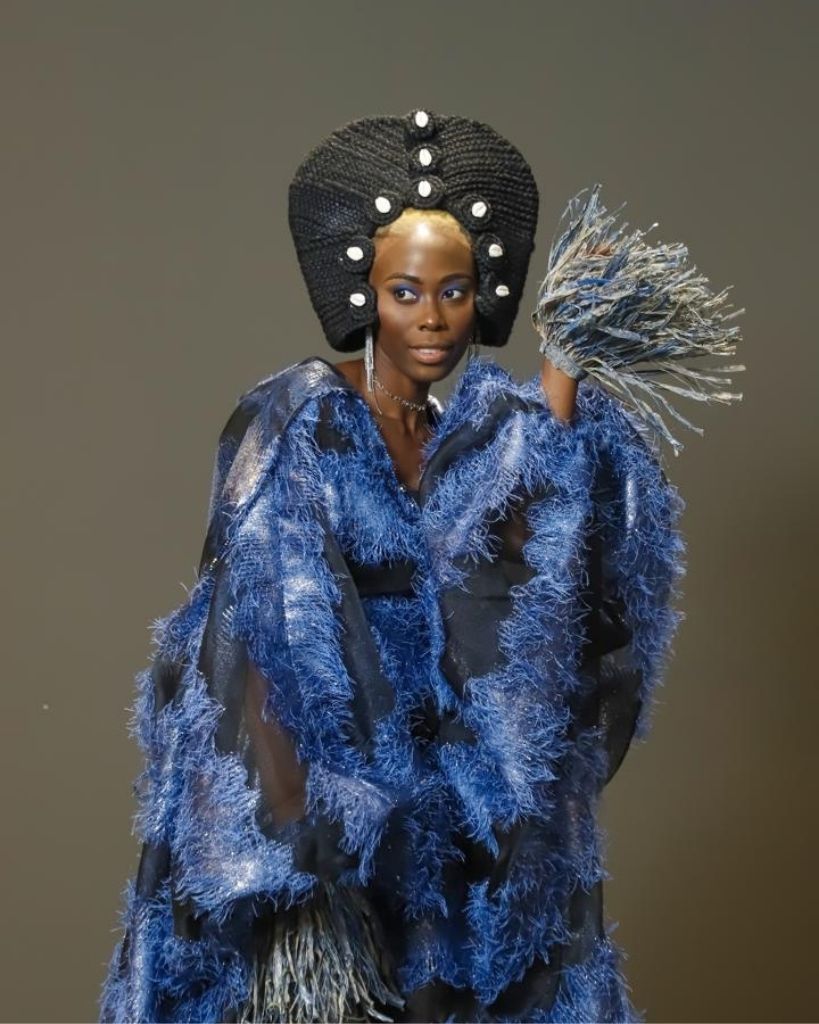
To fuel her creative process, Linda prefers to turn to truly indigenous materials. While West Africa has historically mastered the cultivation and weaving of cotton, Central Africa has developed other forms of ingenuity in working with materials. Linda thus conducts extensive research on plant-based textiles: raffia, traditionally worked by the Pygmies, andtree bark, which is beaten with mallets and then re-soaked to make it as supple and durable as fine leather.
To preserve these techniques and adapt them to modern needs, she actively collaborates with a 20-year-old artisan from the interior of Gabon. Together, they have taken on the challenge of building traditional looms. These tools, which previously could only produce narrow strips 30 to 40 cm wide, have been modified to produce fabric panels one meter wide. This technical innovation allows Linda to cut her pieces in a single piece, eliminating unsightly seams and ensuring a smooth, flowing finish.
Drawing inspiration from the four elements of nature (Earth, Air, Water, and Fire), she enjoys dyeing her raffia fibers herself using natural pigments and combining them with prestigious West African textiles, such as Koko Dunda from Burkina Faso.
A blend of high-end custom-made and ready-to-wear
Based in a workshop adjacent to her home in Libreville, Linda leads a team of three people, including one embroiderer and two seamstresses. This decision to operate on a small scale is strategic: it allows her to personally oversee every stage of garment production, from cutting and pattern-making to finishing and hand embroidery—a craft she learned during her upbringing with the nuns.
The workshop’s activities are organized around two distinct areas:
High-End Custom-Made
Designed for prestigious events, traditional weddings, or international fashion shows, this collection emphasizes total exclusivity and a personal connection with the client during fitting sessions at the showroom.
Limited-edition luxury ready-to-wear
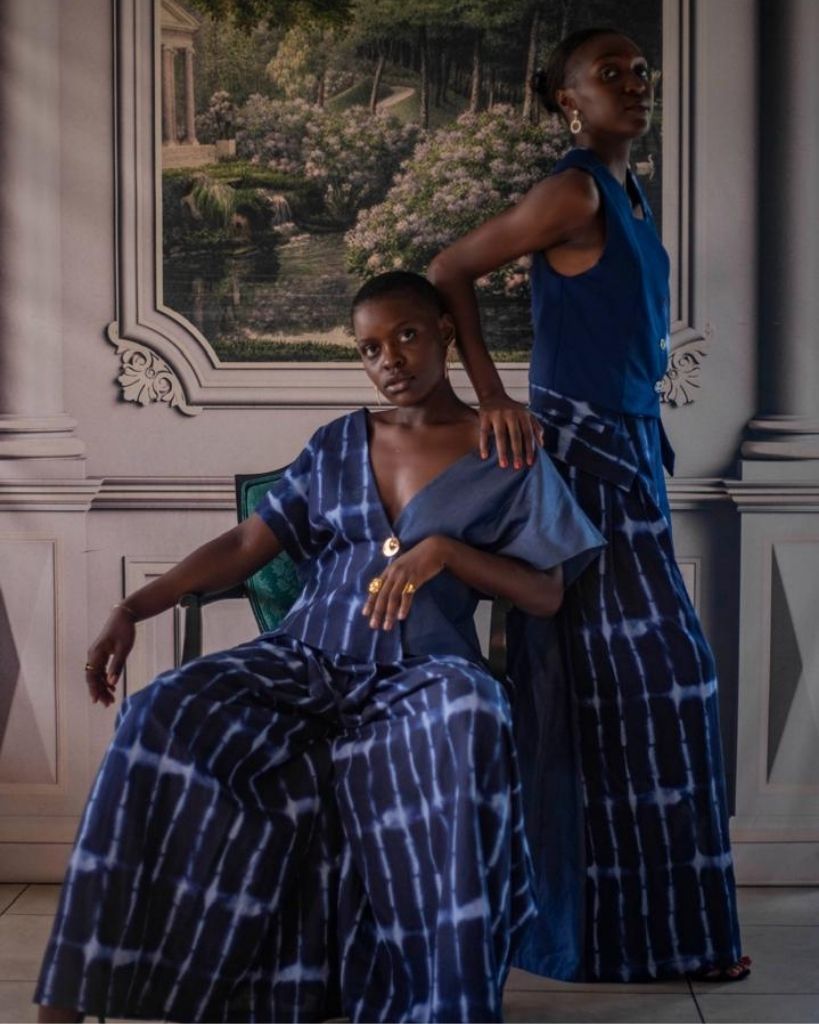
Designed to meet the needs of a small community like Libreville’s, Atelier Issé by Lita’s ready-to-wear collection is produced in micro-batches of no more than five pieces per fabric. Linda designs versatile silhouettes, much like her signature jumpsuits, which she has been creating for the past five years. A “three-in-one” garment can thus be worn casually, transformed for work, or paired with heels and a designer bag for a formal occasion. The atelier also offers a men’s line of lightweight summer ensembles and suits that has been a huge success.
International ambitions
In just five years since its founding, Atelier Issé by Lita has already gained solid international recognition:
- The brand was named International Designer of the Year at a fashion show in Ghana.
- She represented Gabonese excellence at the World Expo in Osaka, Japan, by walking the runway in the prestigious Women’s Pavilion created by Cartier.
- She designed the outfits for the iconic Gabonese singer Tita Nzebi for her concert at the French Cultural Center and for the cover of her latest album.
- Ella took part in the “Parlons Mode 241” pop-up event organized by model and entrepreneur Dorine Mboumba
In September 2026, the brand will reach another major milestone by participating in the prestigious FIMO (International Festival of African Fashion) fashion show organized in Paris by Jacques Logoh— a must-attend event for discovering African brands.
Although she does not currently have her own e-commerce site, Linda Alves Nunes manages her sales directly through her studio in Libreville and on social media, while remaining open to partnerships with concept stores in Paris, Dakar, or Abidjan. By combining the resilience of artisanal craftsmanship with a modern vision of silhouette, Issé by Lita has established itself as a major symbol of Central Africa’s textile excellence.
Read also