Structuring African talent to conquer global markets
The creative effervescence of Africa’s cultural and creative industries (CCI) is undeniable. However, for many young companies, the transition to the international arena remains an uphill battle. For Christel Pinaud, international business development expert and founder of CGHP Bespoke Consulting, the key is to make the essential transition from creator to structured entrepreneur.
Twenty years of brand expertise
Christel Pinaud’s career was marked by an early immersion in the world’s largest distribution networks. Her career began by managing international licenses for prestigious houses such as Ted Lapidus and Balenciaga. She then joined the Zanier children’s fashion group as Sales Director for Jean Bourget and Kenzo Kids.
At the head of a 20-strong team, she travels to over 40 countries, weaving a network of over 1,000 active B2B partners (department stores, agents, distributors) in her preferred zones: Europe, the United States, Asia and the Middle East.
In 2018, she chose to put this solid experience at the service of independent designers, fulfilling a promise she had made as a student. At the age of twenty, while preparing her dissertation on the development of these emerging brands, she had already observed that young designers could not afford the services of the consulting giants. So, at the age of forty, she promised herself she would set up a dedicated structure to support them and promote their uniqueness.
Mapping global expectations

Christel Pinaud, Nya and Maliko
One of the most common mistakes made by exporting brands is to apply a uniform message and offer across the globe. Christel Pinaud reminds us that each geographic zone has its own consumer psychology:
- Middle East (Dubai): In this region, where the climate is sunny all year round, the act of buying is intimately linked to prestige, storytelling and the search for exclusivity. Dubai’s consumers are looking for differentiating niche brands. She wants to be able to tell the story of the garment to her peers: where the piece comes from, how it was made and who created it.
- United States: The American market is characterized by direct, product-driven impulse buying. The American buyer operates on visual impulse: if he likes the product, he buys it immediately, without necessarily looking into the brand’s history or negotiating the price.
- Asia: This is the market for rigor and technical perfection. Asian consumers study a product from every angle, meticulously inspecting the inside and outside of each piece. The slightest imperfection or protruding thread can cancel a sale.
The trap of undervaluation
Another major challenge for African brands is setting export prices. Christel Pinaud insists on the need to decorrelate the local price from the international price:
“You can’t sell a product in Paris or New York at the same price as in Dakar. Exporting generates logistical costs, customs duties, transport and compliance costs, which must be passed on.”
In addition, pricing must be perfectly consistent with the brand’s positioning. If a brand claims a high-end or luxury positioning, with 100% handcrafted production, a price that is too low in Europe or the United States will arouse consumer suspicion as to the quality or authenticity of the piece.
To manage this dual pricing seamlessly, the expert recommends the use of technological tools like Shopify, which can segment offers and prices according to the user’s geographical location.
Reassurance for conversion
Maraz
The main obstacle for designers on the continent is not creativity, but the confidence of international buyers. The latter often have preconceived ideas about delivery times, consistency of production quality and capacity to deliver in volume.
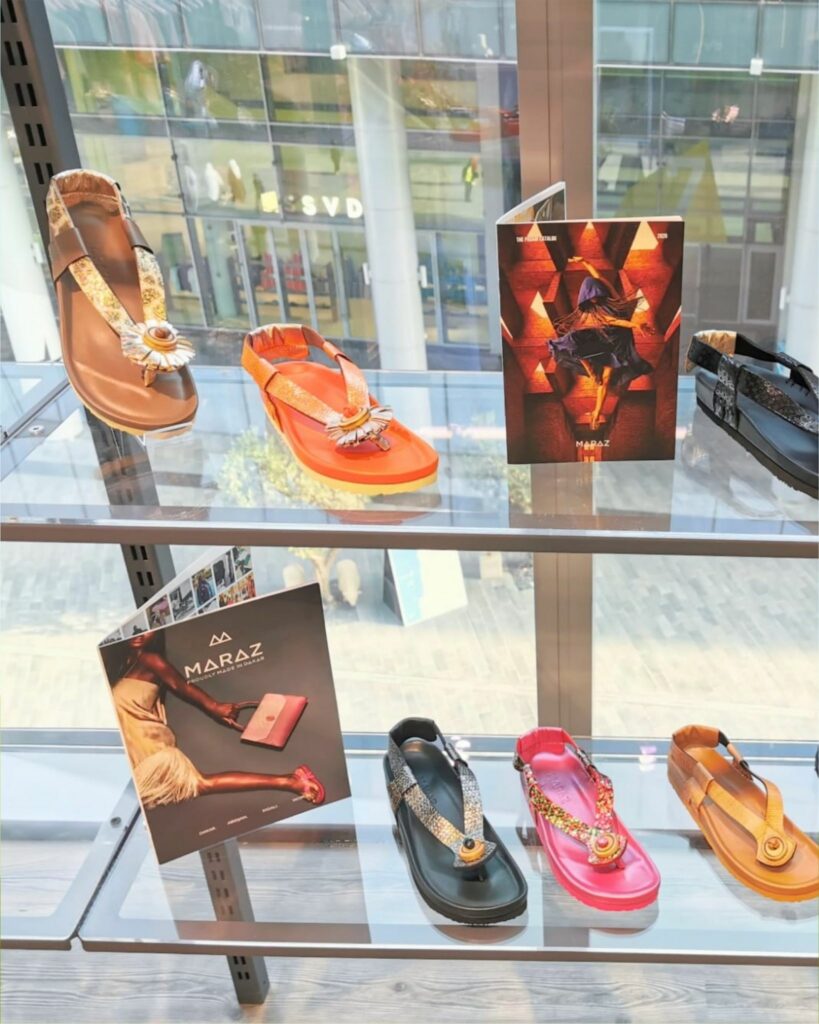
To overcome these barriers, Christel Pinaud offers a three-step approach: sales training, customized operational coaching and active prospecting. It is this rigorous method that has enabled the Senegalese brand Maraz to successfully establish itself in the Middle East.
By focusing on their most differentiating product (the revisited “padam” shoe) rather than on highly competitive leather goods, and by restructuring their sales tools (lookbook, technical line sheet), CGHP Bespoke Consulting enabled Maraz to sign a major distribution contract covering 13 Middle Eastern countries, with physical representation in a prestigious Dubai showroom.
Time to be bold
Today, the international market is showing a real craze for Made in Africa. From Paris to New York, via Tokyo, pop-up stores and corners dedicated to African creation are multiplying in the biggest department stores.
For Christel Pinaud, the message to designers is clear: the doors are open, but access requires rigor. By taking care of its operational structure, sales support and logistical compliance, African fashion has all the cards in hand to establish itself as a key player in the global luxury market.
About Christel Pinaud Founder of CGHP Bespoke Consulting, she supports small and medium-sized businesses in the creative industries in their international structuring and business development.
Read also